Online therapy
Online therapy when you live in a rural or remote area
Long drives, few local options and the feeling that everyone knows your business can make therapy hard to reach in the countryside. Here is how online sessions can help, and what to think about first.
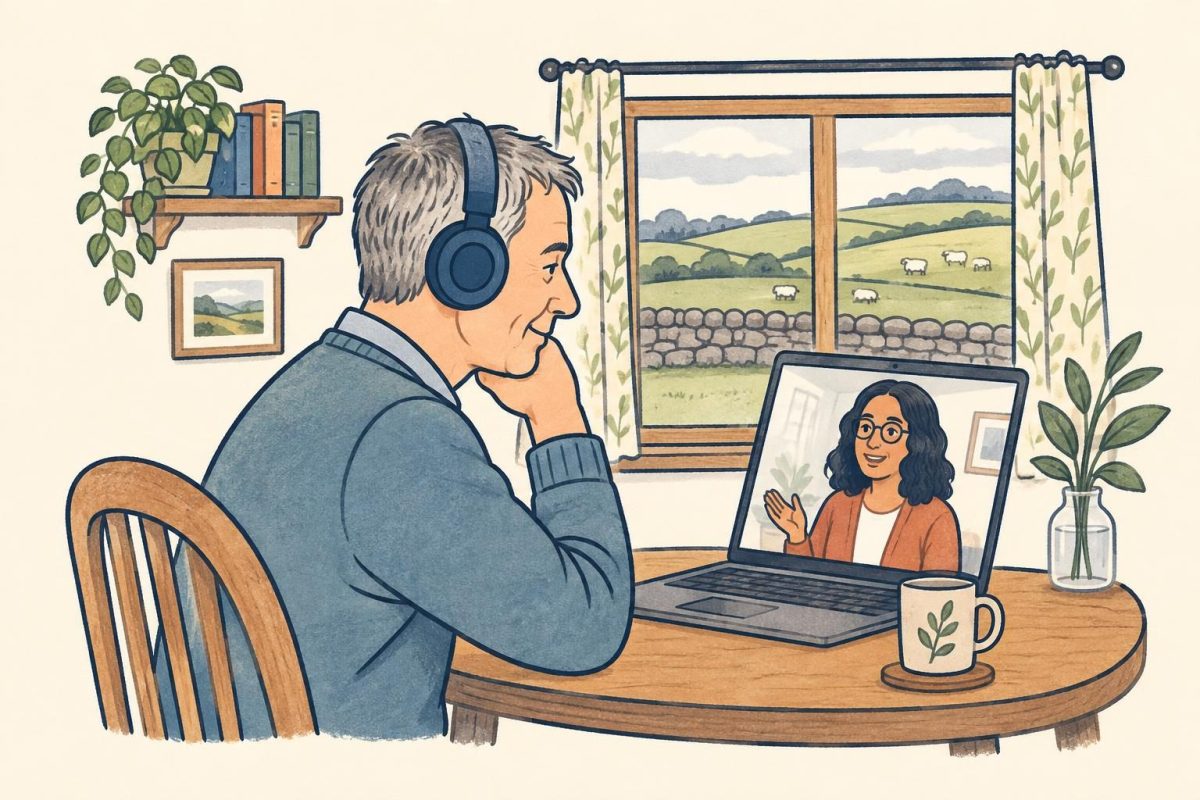
If you live in a village, on a farm, on an island or at the end of a long single-track road, getting support for your mental health can feel like one more thing that is harder than it should be. The nearest therapist might be an hour away. There may be only one or two to choose from. And in a small place, the thought of your car being seen outside a counselling room can be enough to put you off altogether.
Online therapy will not solve every problem that comes with rural life, but for many people it removes some of the biggest barriers. This article looks at what it can offer, what to plan for, and how to make it work where you live.
Why therapy can be harder to reach outside towns and cities
People in rural and remote areas face the same range of difficulties as anyone else, such as anxiety, low mood, grief, stress and relationship problems. What is often different is access.
- Distance and travel. A weekly appointment can mean a long round trip, fuel costs and time off work. In winter, snow, flooding or ferry cancellations can make it impossible to get there at all.
- Limited choice. In a city you might pick from many therapists with different approaches. In a rural area there may be very few, and they may not offer the type of therapy you are looking for.
- Working patterns. Farming, fishing, tourism and other seasonal work often mean early starts, late finishes and busy periods when you cannot leave. Fitting in a fixed appointment in a town can feel impossible.
- A culture of coping alone. Many rural communities value self-reliance. That can be a real strength, but it can also make asking for help feel like admitting defeat.
None of this means your needs matter less. It simply means the usual route into therapy may not suit your life.
Privacy when everyone knows everyone
One of the quieter reasons people in small communities avoid therapy is the worry about being recognised. You might see the local counsellor at the school gate, in the shop or at the village hall. They might know your family, your neighbours or your employer.
Therapists who are registered with professional bodies such as BACP, NCPS or UKCP follow ethical frameworks that include keeping what you share confidential, within certain limits. They also think carefully about what are sometimes called dual relationships, which means knowing a client in more than one way, for example as a therapist and as a neighbour. Even so, some people simply feel more able to open up to someone who has no connection to their everyday world.
Online therapy lets you work with a therapist who lives somewhere else entirely. You will not bump into them at the market, and nobody needs to see you arrive anywhere. For some people, that distance is exactly what makes it possible to talk honestly for the first time.
What online therapy can offer
With online therapy you meet your therapist by video from your own home, or from another private place you choose. For people in rural areas, this can bring several practical benefits.
- No travel. You save the drive, the fuel and the time, and bad weather is less likely to mean a missed session.
- More choice. You can look for a therapist whose approach, experience and availability suit you, rather than relying on whoever is nearest.
- Flexibility. Some therapists offer early morning, evening or weekend sessions, which may fit better around animals, shifts or family.
- Continuity. If you move around for work, or spend part of the year in a different place, you may be able to keep seeing the same therapist.
It is worth knowing that online therapy is not right for everyone or every situation. Some people prefer being in the same room as their therapist, and some difficulties may be better supported in person or alongside other local services. A good therapist will talk this through with you honestly.
Making it work with a patchy connection
Broadband and mobile signal can be unreliable in the countryside, and this is often the first worry people raise. A few simple steps can make a real difference.
Before your session
- If you can, try a short video call with a friend or family member from the spot you plan to use, at the same time of day as your session.
- If your router allows it, a cable plugged directly into your laptop or computer is often steadier than wi-fi.
- Sit as close to the router as you comfortably can, and ask others in the house to pause streaming or large downloads during your session.
- Close other apps and browser tabs you do not need.
- If your home broadband is weak but mobile signal is better, using your phone or a mobile hotspot may help, although this will use data.
Agreeing a plan with your therapist
It helps to agree at the start what you will both do if the call freezes or drops. For example, you might both rejoin the session after a minute, or briefly turn video off to keep the sound going. Knowing there is a plan can take a lot of pressure off, so a dropped connection becomes a small interruption rather than a reason to worry.
Therapists who work online are used to this. A few technical hiccups do not mean the session has failed, and you will not be judged for living somewhere with poor signal.
Finding a private space in a busy or shared home
Rural homes are often shared with family, and you may be working from home as well. Finding somewhere quiet and private for an hour can take a little thought. Some people use a spare room, a bedroom, or even a parked car with headphones if it is warm and safe to do so. The key things are that you can speak freely, you will not be overheard, and you feel reasonably comfortable.
Wearing headphones can help keep your therapist's side of the conversation private. You might also want to give yourself a few minutes before and after the session, rather than going straight back to jobs, so you have time to settle.
Keeping local support in the picture
Online therapy can sit alongside, rather than replace, the support around you. Your GP is still an important person to talk to about your mental health, particularly if you are thinking about medication, if your symptoms are getting worse, or if you have physical health concerns too. Depending on where you live in the UK, your GP may also be able to tell you about NHS talking therapy services, some of which offer phone or video appointments.
It may also help to think about who else is around you. A trusted friend, a family member, a faith community or a local group can all be part of looking after yourself between sessions, even if you choose not to tell them you are in therapy.
Online therapy is not an emergency service. If you are in immediate danger, call 999. For urgent help that is not an emergency, call NHS 111. You can contact Samaritans free on 116 123 at any time, day or night.
When help is far away, it can be useful to note these numbers somewhere easy to find, especially if you live a long way from the nearest hospital.
Taking the first step
If you have been putting off therapy because of distance, cost of travel or worries about privacy, it may be worth looking at whether online sessions could fit your life. You could start by thinking about what you would like help with, what times of day are realistic, and where in your home you could talk privately.
When you are choosing a therapist, check that they are registered with a recognised professional body, and do not be afraid to ask how they handle connection problems or whether they have worked with people in situations like yours. Through WebcamTherapy you can browse registered therapists, book and pay online, and have private video sessions in your web browser, with reminders sent by text and email.
Living somewhere quiet and remote can be a source of great peace, and also of real isolation at times. Whatever your situation, you deserve support that you can actually reach.
WebcamTherapy editorial team
Our articles are reviewed by registered therapists before publishing.
Related articles
Online therapy
What to expect from your first online therapy session
Feeling nervous before your first video session with a therapist is completely normal. Here is a calm, practical guide to what usually happens before, during and after that first appointment.
10 Nov 2026 · 7 min read
Online therapy
Therapy when you live with a chronic illness or disability
Living with a long-term health condition or disability can affect your mood, relationships and sense of self. Here is how therapy can help, and how to make it work around your body and energy.
18 May 2024 · 7 min read
Online therapy
Creating a private, comfortable space at home for video therapy
Where you sit for a video therapy session can shape how settled and open you feel. Here are practical ways to find privacy, reduce distractions and make an ordinary corner of your home feel safe enough to talk.
14 May 2023 · 7 min read