Therapy explained
Mapping your own vicious cycle: a practical way into the CBT model
CBT often starts with a simple diagram that shows how a moment of worry or low mood keeps itself going. Here is how to draw one for yourself, step by step, and what it can reveal.
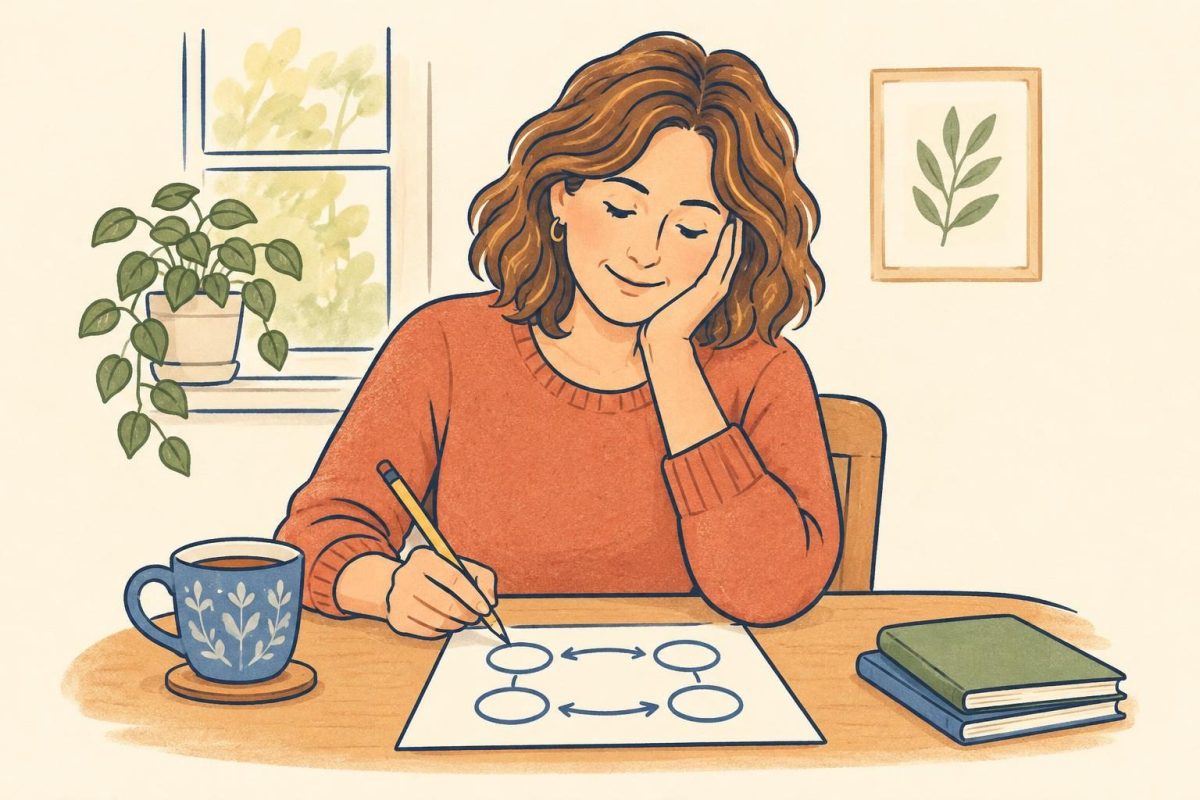
If you have ever started cognitive behavioural therapy (CBT), there is a good chance that one of your early sessions involved a piece of paper and a few circles joined by arrows. Some therapists call it a vicious cycle, others call it a formulation or a five-areas diagram. Whatever the name, it is one of the most useful tools in CBT, because it turns a confusing jumble of feelings into something you can see, understand and begin to change.
This article is a practical walk-through. Rather than explaining the theory in the abstract, it shows you how to map one of your own difficult moments, what to look for once it is on paper, and how a therapist might use it with you. It is general information, not a substitute for advice from your GP or a registered professional about your own situation.
Why draw it at all?
When you feel anxious, low or stuck, everything can seem to happen at once. A thought flashes up, your stomach tightens, you cancel a plan, and later you feel worse without quite knowing why. In the moment, it is very hard to see how these pieces connect.
Writing them down slows things down. It also creates a little distance. Instead of being inside the experience, you are looking at it on a page, a bit like a scientist studying something interesting. Many people find that this alone makes a difficult pattern feel less overwhelming and less like a personal failing.
The diagram also shows something that is easy to miss: the things we do to feel better in the short term can sometimes keep the problem going in the long term. Seeing that clearly is often the first step towards doing something different.
The five parts of the map
A simple CBT map usually has five parts. You do not need to be precise or get it "right". The aim is just to notice.
- The situation. What was happening, where you were, who was there. Keep it factual, as if describing a scene from a film.
- Thoughts. What went through your mind. These might be words ("They think I am boring") or images (picturing yourself freezing mid-sentence).
- Emotions. How you felt, usually in one word: anxious, sad, ashamed, angry, guilty. It can help to rate how strong each one was out of 10.
- Body sensations. What you noticed physically: a racing heart, heavy limbs, a hot face, a knot in your stomach, tiredness.
- Behaviour. What you did, or did not do. This includes obvious actions, like leaving early, and subtle ones, like avoiding eye contact or rehearsing what to say.
In the middle of the page sit the four inner parts (thoughts, emotions, body and behaviour), each linked to the others with arrows going both ways. The situation sits around the outside, because it sets the scene.
A worked example
Imagine someone, let us call them Sam, who is invited to a colleague's leaving drinks. This is an illustration rather than a real person, but the pattern may feel familiar.
Sam's map
- Situation: Friday afternoon, a message in the team chat about drinks after work.
- Thoughts: "I will have nothing to say. Everyone will notice how awkward I am. It is easier not to go."
- Emotions: Anxious (7 out of 10), a bit sad (4 out of 10).
- Body: Tight chest, restless, a slightly sick feeling.
- Behaviour: Replies that they have other plans. Spends the evening at home scrolling on their phone.
In the short term, Sam feels relief. The anxiety drops. But over the weekend, new thoughts appear: "I always miss out. They probably think I am unfriendly." Sadness rises, and the next invitation feels even harder to accept.
When the arrows are drawn in, the cycle becomes clear. The anxious thoughts lead to avoidance, avoidance brings quick relief, and that relief teaches Sam's mind that the situation really was dangerous. Meanwhile, Sam never gets the chance to discover that the evening might have been manageable, or even enjoyable.
How to map one of your own moments
If you would like to try this yourself, choose a moment that was mildly or moderately upsetting rather than something very painful. It is easier to learn the skill on smaller things first.
- Pick a specific moment. "Monday morning when I opened my inbox" works better than "work in general".
- Write the situation in one or two sentences. Stick to what a camera would have recorded.
- Note the strongest emotion first. Emotions are often easier to spot than thoughts. Give it a rating out of 10.
- Ask what was going through your mind. Useful prompts include: what was I afraid might happen? What did this say about me? What picture came to mind?
- Scan your body. Start at your head and move down. What did you notice?
- List what you did next. Include anything you did to cope, hide or get away, however small.
- Draw the arrows. Ask how each part fed into the others. Did a body sensation make a thought feel more believable? Did an action make the feeling ease briefly, then return?
Do not worry if some boxes stay empty or if things seem tangled. That is normal, and it is exactly the kind of thing a therapist can help untangle with you.
Finding the places to step in
Once a cycle is on paper, the hopeful part is that every arrow is a possible place to make a small change. You do not have to change everything at once. Shifting one part can loosen the whole pattern.
Working with thoughts
CBT does not ask you to "think positive". Instead, it invites you to treat thoughts as guesses rather than facts. You might ask: what is the evidence for and against this? What would I say to a friend who thought this? Is there another way of seeing it? Over time, more balanced thoughts can feel more believable.
Working with behaviour
Changing what you do is often the most powerful lever. For Sam, that might mean going to the drinks for half an hour, or staying near one friendly colleague. CBT therapists sometimes call these behavioural experiments: small, planned steps to test out a fear and see what actually happens. With low mood, a related approach called behavioural activation focuses on gradually building back activities that bring a sense of enjoyment or achievement.
Working with the body
Slowing your breathing, gentle movement, or grounding yourself through your senses can take the edge off strong physical sensations. When the body settles a little, thoughts often feel less urgent.
What a CBT therapist adds
You can learn a lot from mapping cycles on your own, and many people find it a helpful habit. A trained therapist adds several things that are hard to do alone.
- A fresh pair of eyes. It is easy to miss your own subtle safety behaviours or deeper beliefs. A therapist can gently point these out.
- Linking patterns together. Over a few sessions, you and your therapist may notice that different situations share the same underlying belief, such as "I am not good enough". This bigger picture can guide the work.
- Pacing. A therapist helps you choose steps that stretch you without overwhelming you.
- Between-session practice. CBT usually involves some practice between sessions, such as keeping simple records or trying an experiment. Your therapist helps you plan this and make sense of what you learn.
CBT is well researched, and NICE recommends it as a treatment option for depression and for a range of anxiety disorders. Even so, no therapy suits everyone, and how well it works depends on many things, including the fit between you and your therapist. If CBT does not feel right, other approaches may suit you better.
A gentle note on getting support
Mapping a cycle is meant to bring clarity, not pressure. If writing things down stirs up more than you expected, it is fine to stop, take a break and come back to it later, perhaps with support.
If you have been feeling low or anxious for a while, talking to your GP is a good starting point. You can also look for a therapist who offers CBT; on WebcamTherapy, for example, you can book a private video session with a therapist registered with BACP, NCPS or UKCP.
Online therapy is not an emergency service. If you are ever in crisis or worried about your safety, call 999 in an emergency, call NHS 111, or contact Samaritans free on 116 123 at any time, day or night.
WebcamTherapy editorial team
Our articles are reviewed by registered therapists before publishing.
Related articles
Therapy explained
How CBT works: the links between thoughts, feelings and behaviour
Cognitive behavioural therapy is built on a simple idea: what we think, how we feel and what we do all affect each other. Here is how that cycle works, and how CBT helps you change it.
10 Nov 2026 · 7 min read

Therapy explained
How to tell if a therapist is the right fit for you
The relationship you have with your therapist matters. Here is how to notice whether it is working, how to tell normal discomfort from a poor match, and what to do if you want to change.
22 Jul 2024 · 7 min read

Therapy explained
Person-centred therapy explained: being heard on your own terms
Person-centred therapy trusts that you are the expert on your own life. Here is what it involves, what sessions are like, and who it may suit.
20 Apr 2024 · 7 min read